You begin with the loveliest of intentions: finding a birthstone gift for somebody special. Then you discover their stone is a diamond. Or an emerald. Or a ruby.
Suddenly, a thoughtful birthday gift is beginning to look rather more like a significant financial commitment.
Perhaps cost is not the issue at all. Perhaps you simply do not like your traditional birthstone. You might be an October baby who has never felt drawn to opal, or love every colour except September’s customary sapphire blue. A stone assigned to you by the calendar does not automatically become your stone.

I’m Laura, the founder of Rock + Realm. I have loved crystals since childhood and now spend my days carefully selecting them, learning their stories and helping customers find pieces that feel personal to them. My own February birthstone is amethyst, which was one of the first crystals I collected as a child. Yet the crystal that drew me back into this world as an adult, and eventually helped inspire Rock + Realm, was fluorite.
Both feel connected to my story. Neither feels like a lesser choice.
That is the spirit of this guide. We will explore the traditional birthstone for every month, some of the more surprising alternatives that history has given us and my favourite affordable crystal swaps. Some resemble the original gemstone, others share its symbolism and a few simply offer a much better match for the person receiving them.
Because the most meaningful birthstone is not necessarily the most expensive one, or even the one printed on a birthday card. It is the stone that makes somebody say, “That feels like me.”
Already know which month you need?
January · February · March · April · May · June · July · August · September · October · November · December
Where did birthstones come from?
Humans have attached meaning to coloured stones for thousands of years, although the neat month-by-month list we know today is a much more recent creation.
One commonly repeated theory connects birthstones with the twelve stones described on the breastplate of Aaron in the Book of Exodus. Later writers attempted to link those stones with the twelve months, zodiac signs or apostles, although translations and ancient gemstone names make exact matches difficult. It is better understood as one thread in the story than as a definitive origin.

For much of history, people did not necessarily wear only the stone connected with their own birthday. Some collectors owned all twelve and changed them with the months, believing each stone was especially potent during its appointed time.
The recognisable modern list was formalised by the American National Association of Jewellers in 1912. Other organisations and countries produced their own versions, and stones have continued to be added as fashions, availability and marketing have changed. Tanzanite, for example, was only discovered in the 20th century and later joined December’s already rather crowded collection of birthstones.
In other words: birthstone tradition has never been quite as fixed as it appears. The list is a starting point, not a rulebook.
What is an alternative birthstone?
An alternative birthstone is a gem or crystal chosen in place of the best-known stone for a particular month.
Sometimes it is already a recognised birthstone that receives less attention. Moonstone belongs to June alongside pearl and alexandrite, while sardonyx is not merely an inexpensive substitute for peridot but the original August birthstone, with a history stretching back thousands of years.
Others are Rock + Realm swaps, selected because they offer:
- A similar colour, such as Green Aventurine in place of Emerald
- Complementary symbolism, such as Rose Quartz as a softer expression of Garnet’s associations with love and devotion
- A more accessible way to give a natural stone without entering fine-jewellery territory
- A character or traditional meaning that may suit the recipient rather better
January: Garnet and Rose Quartz
Traditional birthstone: Garnet
Our alternative: Rose Quartz
Garnet is usually pictured as a deep wine-red stone, but the garnet family is far more colourful than its reputation suggests. Garnets can also be green, orange, pink and, in rare cases, blue. Its name is thought to come from a word connected with pomegranate, inspired by the resemblance between red garnet crystals and the fruit’s glossy seeds.

There is also a lovely local connection. Garnets feature prominently in the extraordinary Anglo-Saxon metalwork found at Sutton Hoo, just over the border from us in Suffolk. Research suggests that some of those tiny stones may have travelled from as far away as southern Asia before being set into the burial treasures some 1,400 years ago. A very early example of the surprisingly global journeys our crystals can take.
Garnet has long been associated with devotion, strength and enduring connection. For a gentler interpretation of those themes, I love Rose Quartz as January’s alternative.
Its soft pink colouring shifts the emphasis from fiery passion towards compassion, affection and emotional warmth. It is an especially thoughtful choice for a close friend, partner, mother or anybody who could do with being reminded to extend some of their care towards themselves.
A Rose Quartz bracelet makes an easy everyday gift, while a heart, palm stone or small display piece feels a little more tactile and personal.
February: Amethyst and Fluorite
Traditional birthstone: Amethyst
Our alternative: Fluorite
Amethyst has one of the best names in gemstone history. It comes from the ancient Greek amethystos, meaning “not intoxicated”. The Greeks and Romans believed the purple stone could protect against drunkenness, and it was sometimes carved into drinking vessels or worn during particularly enthusiastic feasting. Sadly, there is no evidence that an amethyst bracelet will rescue you from a third glass of wine, but it is a wonderful story.

Its regal purple colour later made amethyst a favourite of religious leaders and royal collections. Today it is traditionally associated with calm, clear thinking and spiritual awareness.
As a February baby, I have always loved amethyst. I searched for it in gift shops and museum shops as a child, long before I understood how crystals formed or why people gave them meaning.
My personal alternative is Fluorite. Its translucent bands of purple, green and blue can look like watercolour suspended inside stone, and no two pieces feel quite alike. It is traditionally associated with focus, creativity and bringing a little order to a busy mind.
Fluorite was the crystal that recaptured my attention in 2019 and opened the door to everything that eventually became Rock + Realm. I did not choose it because it was an inexpensive version of amethyst. I chose it because I could not stop looking at it.
Fluorite is softer than quartz, so I tend to recommend a polished piece, palm stone or beautiful specimen that can live somewhere safe rather than jewellery intended for hard daily wear.
March: Aquamarine and Bloodstone
Recognised birthstones: Aquamarine and Bloodstone
Our affordable choice: Bloodstone
March offers two birthstones that could hardly look less alike.
Aquamarine takes its name from the Latin words for seawater. Ancient mariners carried it in the belief that it could calm rough waves and protect them on their voyages. It was also thought to support a happy marriage, which perhaps explains why it now belongs to both birthday and anniversary traditions.
Bloodstone is darker and earthier: usually deep green with small red inclusions created by iron oxides. Its older name, heliotrope, comes from Greek words meaning “sun-turning”. In antiquity, people reportedly believed that placing it in water could make the reflected sun appear red. Later Christian folklore interpreted its markings as drops of Christ’s blood.

There is no need to treat Bloodstone as second best. It is a recognised March birthstone in its own right and has accumulated quite enough strange and dramatic folklore to hold its own.
Traditionally associated with courage, resilience and renewed strength, it makes a grounding gift for somebody beginning again, facing a challenge or finding their feet after a difficult season. Its mottled markings also make it a good choice for somebody who prefers natural, earthy crystals to delicate sparkle.
April: Diamond, Clear Quartz and Herkimer Diamond
Traditional birthstone: Diamond
Our alternatives: Clear Quartz and Herkimer Diamond
Diamond is not merely hard; for centuries it has been burdened with almost impossible levels of symbolism. The Roman naturalist Pliny the Elder described it as the most valuable of all worldly things, and different cultures have imagined diamonds as splinters of stars, tears of the gods or lightning made solid.
All of which is enchanting until you look at the price.
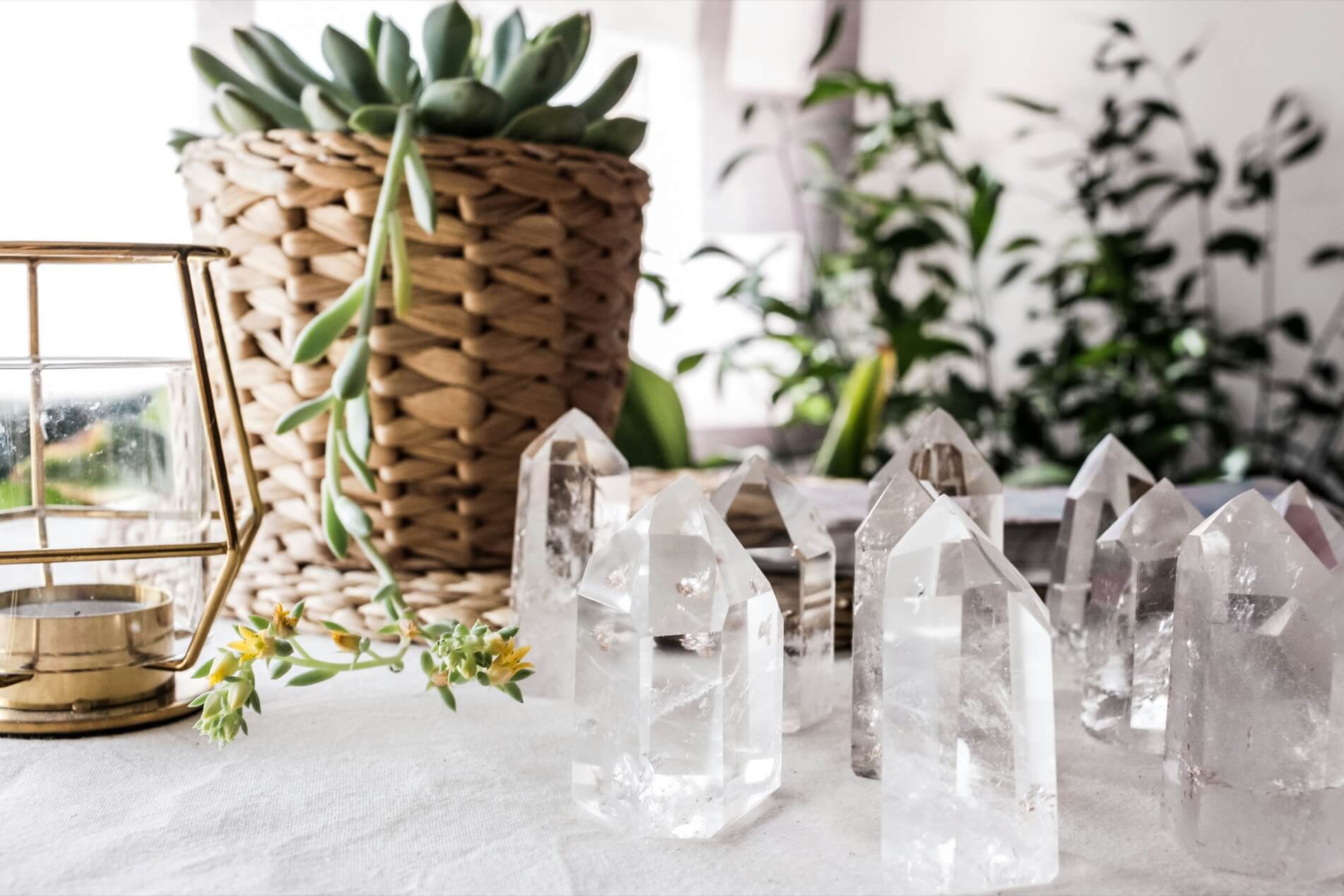
Clear Quartz gives April birthdays a natural crystal option with brightness, clarity and plenty of sparkle of its own. It is sometimes called Rock Crystal, a name that helps distinguish beautifully transparent quartz from the more ordinary image the word “quartz” may conjure.

For something a little more unusual, try a Herkimer Diamond. Despite the name, it is not a diamond but a particularly clear form of quartz first associated with Herkimer County in New York. Its crystals naturally grow with points at both ends and can develop striking facets without being cut into shape.
That natural geometry is what makes Herkimers so appealing. They look as though somebody has carefully fashioned them, yet the earth has already done the work.
Clear Quartz is traditionally associated with clarity, intention and amplification, making it a versatile gift when you are unsure which quality would feel most relevant to the recipient. It works particularly well as a point, cluster, bracelet or small stone for a desk or bedside table.
May: Emerald and Green Aventurine
Traditional birthstone: Emerald
Our alternative: Green Aventurine
Few stones have inspired devotion quite like Emerald. Cleopatra was famously passionate about it, while emeralds also captivated rulers across the Inca world and later colonial South America. Its intense colour became so synonymous with green that we still use “emerald” as a colour in its own right.
The finest Emeralds can be extraordinarily valuable, but their inclusions are not always treated as flaws. Jewellers traditionally describe an Emerald’s internal landscape as its jardin, the French word for garden. I rather like the idea that even one of the world’s most precious gemstones is expected to carry a little wildness inside it.
For an affordable May birthstone, I recommend Green Aventurine.

Its fresh, leafy colour keeps the connection with spring, growth and renewal, while tiny mineral inclusions can give it a delicate shimmer known as aventurescence. It is traditionally associated with optimism, opportunity and having the confidence to step towards something new.
Green Aventurine is also wonderfully giftable. It is available as bracelets, worry stones, hearts, tumblestones and larger polished pieces, so you can choose something that suits both the person and your budget.
For somebody starting a new job, business, home or chapter of life, it feels especially fitting.
June: Pearl and Moonstone
Recognised birthstones: Pearl, Moonstone and Alexandrite
Our crystal choice: Moonstone
Pearl is unusual among birthstones because it is created by a living creature rather than formed inside the earth. Layers of nacre build around an irritant within a mollusc, gradually producing the lustrous surface that has fascinated humans for centuries.
Pearls have been symbols of wealth, purity and status, although their organic origins make them rather different from the crystals we usually work with at Rock + Realm.
Fortunately, June also belongs to Moonstone.

Its mysterious sheen is caused by light scattering between extremely fine layers within the feldspar crystal. Gemmologists call the effect adularescence, but it looks rather more romantically like moonlight moving across water.
Moonstone comes in more variety than many people realise. Alongside familiar creamy stones, you may find peach, grey, black and rainbow varieties, each with its own character. Rainbow Moonstone’s bright blue flashes can be particularly dramatic when the light catches them.
Traditionally associated with intuition, cycles and new beginnings, it makes a thoughtful gift for a new parent, somebody moving home or anyone passing through a period of change.
Choose a smooth palm stone or pendant to make the most of its shifting light. It is a stone that rewards being picked up, turned over and admired from every angle.
July: Ruby and Carnelian
Traditional birthstone: Ruby
Our alternative: Carnelian
Ruby has never been a shy gemstone. In ancient Sanskrit it was known as ratnaraj, the “king of precious stones”, while warriors in Myanmar were said to believe rubies could make them invincible in battle. Some stories went further than simply wearing one: the stone apparently needed to become part of the body. Please consider a bracelet the much more sensible modern option.
The most coveted traditional Ruby colour is still described in the gem trade as “pigeon’s blood”, a phrase that is accurate enough but unlikely to make its way into our romantic gift messaging.
For July, Carnelian offers the same sense of heat and vitality in glowing shades of orange, rust and red.
Carnelian has its own ancient pedigree. It was carved into beads, amulets and seals across Egypt, Rome and the Near East. Its fine-grained surface made it particularly useful for signet rings because hot sealing wax did not readily stick to the stone.
Traditionally associated with courage, confidence and creativity, Carnelian makes a lively gift for somebody who is launching something, performing, travelling or learning to take up a little more space.
It is also one of the most accessible crystals to give. A small tumble can carry just as much rich colour as a more elaborate piece.
August: Peridot and Sardonyx
Recognised birthstones: Peridot, Sardonyx and Spinel
Our alternative choice: Sardonyx
Peridot has one of the most extraordinary origin stories of any birthstone. It forms deep within the earth’s mantle and can be carried towards the surface by volcanic activity. Some Peridot has even been found inside meteorites, including material left over from the formation of our solar system. August babies can therefore quite reasonably claim a birthstone from both beneath the earth and beyond it.

Yet Peridot was not August’s first stone. That honour belongs to Sardonyx, which has been connected with the month for more than 4,000 years.
Sardonyx combines layers of sard, usually reddish brown, with contrasting bands of onyx. Ancient craftspeople used the different coloured layers to carve cameos and intaglios, cutting away one level to reveal another beneath it.
Its earthy stripes are quite different from Peridot’s sharp green, but they make every piece individual. Traditionally associated with stability, courage and strong foundations, Sardonyx suits somebody practical, dependable or quietly determined.
It is a particularly good alternative for an August birthday person who does not wear lime or olive green and has spent years wondering what they did to deserve Peridot.
September: Sapphire and Blue Lace Agate
Traditional birthstone: Sapphire
Our alternative: Blue Lace Agate
Sapphire has long been connected with truth, loyalty and nobility. Medieval clergy wore blue sapphires because the colour represented Heaven, while ancient Greek and Roman elites believed the stone could offer protection from harm and envy.
Although “sapphire” usually conjures a deep royal blue, sapphires occur in almost every colour except red. Red corundum receives a different name altogether: Ruby. One especially prized pink-orange variety is called padparadscha, after the colour of a lotus flower.
Blue Topaz is often suggested as a less costly sapphire substitute, but most of the vivid blue material available today began as colourless Topaz and was treated using irradiation and heat. The resulting colour is stable, and treatment is standard within the gemstone industry, but I believe it should always be described transparently.
For a naturally pale-blue crystal, my preferred Rock + Realm alternative is Blue Lace Agate.

Its soft bands look almost like ripples, clouds or delicate lace trapped in stone. Traditionally associated with calm communication and finding the confidence to say what needs to be said, it keeps Sapphire’s connection with truth but expresses it in a much gentler voice.
It makes a thoughtful gift for a teacher, writer, speaker or somebody entering a season in which they need to advocate for themselves.
October: Opal, Tourmaline and Labradorite
Recognised birthstones: Opal and Tourmaline
Our additional alternative: Labradorite
Opal is a gemstone that seems designed to attract legends. Ancient Romans saw it as a symbol of love and hope. Arabic stories claimed that opals fell from the sky in flashes of lightning, while Greek tradition credited them with the power of prophecy.
Pliny the Elder marvelled that one opal could contain the red of Ruby, green of Emerald, yellow of Topaz, blue of Sapphire and purple of Amethyst. It was effectively the entire jewellery box in one stone.
The idea that opals are unlucky for anybody not born in October is surprisingly recent. Much of the superstition has been traced to the 19th-century novel Anne of Geierstein by Sir Walter Scott rather than to an ancient curse. For most of history, opal was considered exceptionally fortunate.
Tourmaline is October’s other recognised birthstone and comes in an extraordinary range of colours. Mixed Tourmaline is perfect for somebody who prefers a colourful, lively piece rather than Opal’s milky shimmer.

When it is Opal’s shifting light that appeals, I also suggest Labradorite. Its surface may initially appear grey, but movement reveals blue, green, gold and occasionally purple flashes. That element of surprise makes it a wonderful choice for somebody who does not reveal everything about themselves at first glance.
Labradorite is traditionally associated with protection, intuition and navigating change. Choose a palm stone, pebble or pendant with a strong flash and it becomes the kind of gift people cannot resist tilting towards the light.
November: Topaz, Citrine and Tiger’s Eye
Recognised birthstones: Topaz and Citrine
Our additional alternative: Tiger’s Eye
Topaz and Citrine have spent a surprising amount of history being mistaken for one another. Before modern gemmology could distinguish minerals precisely, many transparent golden stones were simply called Topaz. Citrine inherited some of Topaz’s folklore as a result, including beliefs that it could calm tempers and soothe its wearer.
Citrine is not an unofficial substitute. It is one of November’s recognised birthstones and has appeared in jewellery since ancient times.

There is, however, something worth knowing before buying it. Naturally golden Citrine is relatively uncommon. Much of the Citrine sold across both jewellery and crystal shops is Amethyst that has been heated until its purple colour changes to yellow or orange. The treatment is stable, but the appearance can be quite different from naturally occurring Citrine.
At Rock + Realm, we only sell natural Citrine, which means it may not always be available and it usually costs more than our other small crystals.
When it is out of stock, Tiger’s Eye is an excellent alternative. Its golden-brown bands produce a silky line of reflected light that moves across the surface as the stone turns. This optical effect is known as chatoyancy, from the French for “cat’s eye”.
Traditionally associated with courage, confidence and grounded decision-making, Tiger’s Eye is a good gift for somebody taking a practical leap: an interview, a new business, an exam or a change of direction.
December: Turquoise, Tanzanite and Amazonite
Recognised birthstones: Turquoise, Tanzanite, Zircon and Lapis Lazuli
Our additional alternative: Amazonite
December is the month that refused to settle for a single birthstone.
Turquoise is among the oldest gems used for personal adornment and has been valued by cultures across the world. Tanzanite, by contrast, is a very modern arrival. The blue-violet variety of zoisite was discovered in Tanzania in the 1960s and named by Tiffany & Co. after the only country in which it is commercially mined. It later became one of December’s recognised birthstones.
Lapis Lazuli also has a remarkable history. The deep-blue rock was traded across vast distances and later ground into ultramarine pigment, once more expensive than gold and reserved by European artists for the most important areas of a painting, including the robes of the Virgin Mary.
Why you will not currently find Lapis Lazuli at Rock + Realm
Much of the world’s Lapis Lazuli has historically come from Afghanistan, where the trade has been linked with conflict, illegal extraction and funding for armed groups. Since the Taliban returned to power, I have not been able to obtain the level of supply-chain assurance I would need to feel comfortable stocking it. Until I can verify a source that meets Rock + Realm’s ethical standards, I have chosen not to promote or sell Lapis Lazuli. It remains a recognised December birthstone, but it is not one of our current shopping recommendations.
For a softer and more accessible blue-green choice, I like Amazonite.
Despite its adventurous name, Amazonite is not known to occur in the Amazon in significant quantities. The name may have arisen from confusion with other green stones reportedly seen in the region, which proves that enticing crystal marketing is not an entirely modern invention.

Amazonite is traditionally associated with harmony, honest expression and protecting your peace. Its varied blue-green colour makes it a lovely choice for somebody who wants a calm, contemporary alternative to December’s precious gemstones.
December’s generous range means there is no need to force the match. Choose Turquoise for a classic look, Tanzanite for something rare and refined or Amazonite for a more accessible crystal gift.
How to choose a birthstone gift they will genuinely love
Begin with the birth month, but do not end there.
Consider the colours the recipient actually wears and surrounds themselves with. Somebody whose wardrobe is full of soft neutrals may connect with Rose Quartz or Moonstone more readily than a vivid red Garnet. A person who loves earthy greens and browns may prefer Bloodstone or Sardonyx to a faceted precious gem.

Think about how they might enjoy the crystal:
- A bracelet for somebody who likes to carry their stones with them
- A tumblestone or worry stone for a discreet pocket-sized keepsake
- A palm stone for meditation, quiet rituals or simply something comforting to hold
- A heart or meaningful shape for a more obviously sentimental gift
- A display piece for somebody who loves crystals as part of their home
You can also move beyond birthdays altogether. Choose a partner’s stone, combine the birthstones of children or grandchildren, or mark the month in which an important event took place.
Make the meaning personal
One of the loveliest ways to personalise the gift is to include a short note explaining your choice:
“I chose Carnelian because July’s traditional Ruby felt a little formal for you, while this has the same warmth and courage with much more of your spark.”
That story is what transforms a pretty crystal into a keepsake.
Are crystal meanings factual?
The historical beliefs and modern crystal associations included in this guide form part of gemstone folklore, spiritual traditions and contemporary crystal practice. They should not be treated as scientifically proven effects or used in place of appropriate medical support.
You do not have to believe that a stone possesses a particular power to find meaning in it. A crystal can act as a personal symbol, a reminder of an intention or simply a beautiful fragment of the natural world selected with care.
Meaning matters more than following the rules
Birthstone lists can be useful. They give us a place to begin and connect our gifts with stories that have travelled through cultures and centuries.
But those same stories show us that the lists have never been immovable. Stones have been mistaken for one another, renamed, added, removed and reinterpreted. Some were worn for protection, some ground into pigments and others apparently expected to prevent drunkenness or make warriors invincible.
Against that history, choosing Rose Quartz instead of Garnet or Green Aventurine instead of Emerald feels rather modest.
My own favourite crystal found me because I was drawn to it, not because a chart said it belonged to February. That is ultimately how I recommend choosing for yourself or somebody you love.
Start with the month. Learn the story. Then notice which stone keeps pulling your attention back.
That one is usually worth a closer look.

Frequently asked questions about alternative birthstones
Click to open and discover more about birthstones >
What are the traditional birthstones for each month?
The best-known modern birthstones are Garnet for January, Amethyst for February, Aquamarine and Bloodstone for March, Diamond for April, Emerald for May, Pearl, Moonstone and Alexandrite for June, Ruby for July, Peridot, Sardonyx and Spinel for August, Sapphire for September, Opal and Tourmaline for October, Topaz and Citrine for November and Turquoise, Tanzanite and Zircon for December. Lapis Lazuli also appears on some traditional lists. Birthstone lists can vary between countries, historical periods and jewellery organisations.
Can I choose a different stone from my traditional birthstone?
Yes. Birthstone traditions have changed over time and several months already have more than one recognised stone. You can choose an alternative for its colour, symbolism, affordability or simply because it feels more personal. A birthstone should offer inspiration rather than restrict your choice.
What are the best affordable birthstone alternatives?
Some of our favourite affordable crystal swaps are Rose Quartz for January’s Garnet, Fluorite for February’s Amethyst, Clear Quartz for April’s Diamond, Green Aventurine for May’s Emerald, Carnelian for July’s Ruby, Blue Lace Agate for September’s Sapphire and Amazonite as an additional December option.
Can I give somebody a birthstone that is not from their birth month?
Absolutely. People often wear or carry the birthstone of a partner, child or loved one. You could also choose a crystal connected with an anniversary, an important month or qualities that feel meaningful to the recipient. The thought behind the choice matters more than strict adherence to a list.
Which birthstones are commonly treated?
Many gemstones are treated to improve their colour or appearance. Most Blue Topaz begins as colourless Topaz before irradiation and heating, while much of the Citrine on the market is heat-treated Amethyst. Treatments are not automatically a problem, but reputable sellers should describe them clearly so you understand what you are buying.
Are alternative crystal birthstones suitable for jewellery?
Many are, but durability varies. Quartz-family stones such as Rose Quartz, Clear Quartz, Green Aventurine, Carnelian, Citrine and Tiger’s Eye are generally suitable for bracelets and pendants. Softer or more fragile crystals, including Fluorite, are better chosen as protected jewellery, palm stones or display pieces. Always follow the care guidance provided for the individual crystal.
Are alternative birthstones meaningful if I do not believe in crystal healing?
Yes. A crystal can be meaningful because of its colour, natural formation, historical story or connection with the person who gave it. Traditional crystal meanings can add another layer, but no particular belief is required to appreciate a thoughtfully chosen birthstone gift.